Building InvoicePilot: Solving the Cross-Border Invoicing Problem for Freelancers
A solo project built to eliminate the tax compliance headache that every global freelancer knows too well.
The Problem
If you've ever tried billing clients in Germany, the UK, and the US in the same month, you already know the pain.
Each country has different invoice formats, required fields, VAT rates, and legal notes. EU B2B transactions may require reverse charge handling. UK rules changed after Brexit. US clients don't use VAT at all. And you're expected to figure all of this out before you get paid — every single time.
Existing tools like FreshBooks and QuickBooks are solid, but they're built for US-based businesses billing US clients. For cross-border freelancers, they consistently fall short. No one has made this their primary focus. That gap is where InvoicePilot comes in.
What InvoicePilot Does
InvoicePilot is a full-stack SaaS platform that automates legally compliant invoice generation for 30+ countries. You select the client's country, and the platform handles the rest — correct format, required tax fields, VAT/GST/Sales Tax calculation, reverse charge detection, and country-specific PDF output.
Target users: solo freelancers, small digital agencies, cross-border consultants, and e-commerce sellers working across multiple markets.
How It's Built
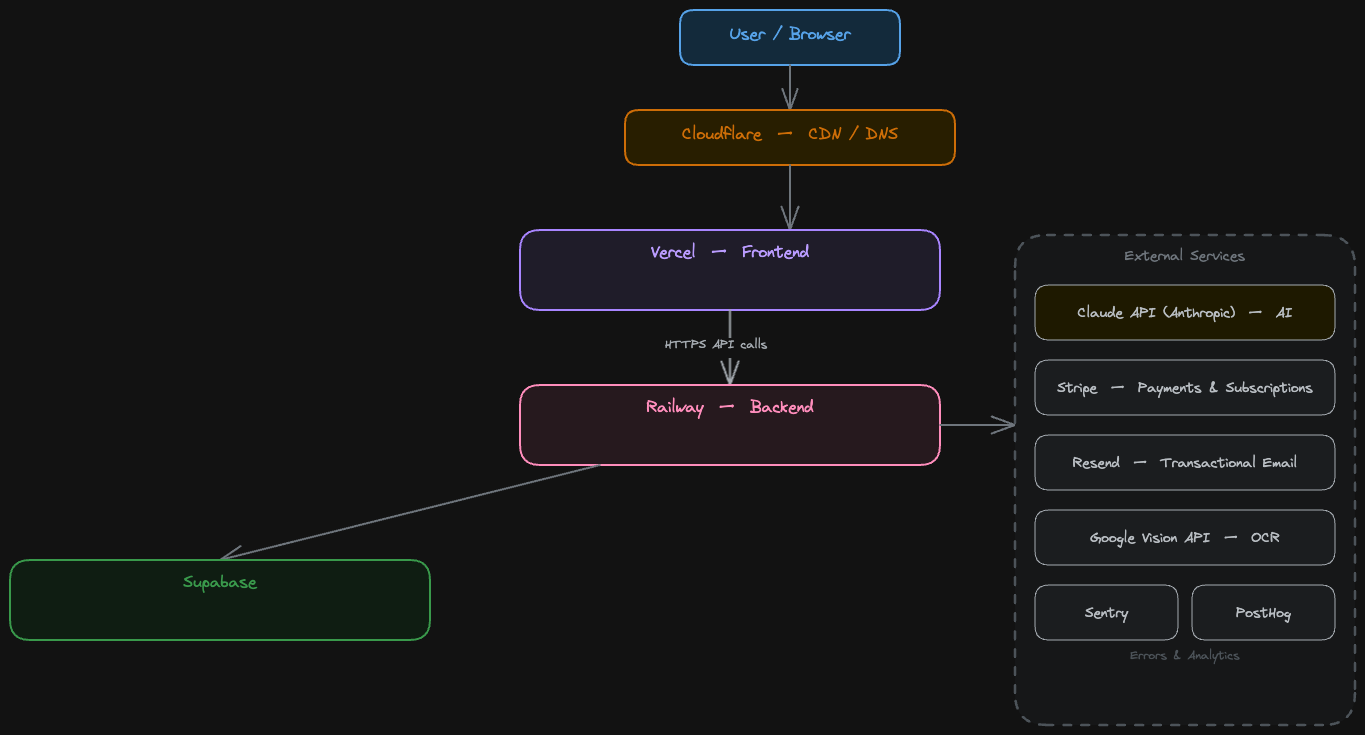
Stack: Python + FastAPI on the backend, React + TypeScript + TailwindCSS on the frontend, PostgreSQL via Supabase, deployed on Railway and Vercel.
The architecture is deliberately simple — a monolithic FastAPI application to start. Fast to build, easy to debug, cheap to run. When volume grows, the compliance engine and PDF generator can be extracted into separate services. No premature complexity.
Tax Compliance Engine
The core of the product is a rules engine covering VAT, GST, and Sales Tax for 30+ countries. Beyond just calculating rates, it automatically detects whether reverse charge applies for EU B2B transactions and validates VAT numbers in real time via the VIES API — two things that trip up a lot of freelancers working with European clients.
pythonTAX_RATES = {
    "DE": {"rate": Decimal("19"), "type": "VAT", "name": "Germany"},
    "US": {"rate": Decimal("0"),  "type": "Sales Tax", "name": "United States"},
    "AU": {"rate": Decimal("10"), "type": "GST",  "name": "Australia"},
    # 30+ countries
}
One important design decision here: Claude is positioned as an informational assistant, not a tax advisor. Every output carries a clear disclaimer pointing users to consult a qualified accountant. This matters both legally and for user trust.
E-Invoice Support
For freelancers working with EU public sector clients, the platform generates UBL 2.1 (Peppol) and Factur-X format e-invoices — a legal requirement in several EU countries for government contracts. Country-specific PDF templates for Germany, the UK, and Turkey are also included out of the box, with the correct required fields pre-populated.
Expense Tracking with OCR
Upload a receipt photo and Google Vision API / Tesseract extracts the data automatically — date, amount, vendor. Claude then categorizes it and suggests whether it qualifies as a deductible business expense. Monthly P&L reports are generated from this data, giving freelancers a clear picture of their actual profitability per project.
Payments and Subscriptions
Full Stripe integration handles the subscription lifecycle — plan selection, billing, webhook processing, and feature gating based on plan tier. If a Starter plan user tries to create more invoices than their plan allows, the system catches it at the plan_limits layer and routes them to the upgrade flow.
Infrastructure
One of the goals from the start was keeping infrastructure costs low enough that the project could survive without revenue for a while.
Sentry handles error tracking, PostHog handles product analytics. Both are more than sufficient on free tiers at MVP scale.
Key Takeaways
Narrow the niche. "Invoice tool for everyone" is a crowded and expensive space to compete in. "Compliance-first invoicing for cross-border freelancers" is specific, defensible, and underserved. Existing players treat it as an edge case. That's your opening.
Use AI where the friction is real. Tax compliance research is exactly the kind of task people dread — time-consuming, error-prone, and high stakes. AI adds genuine value here, not as a feature checkbox, but as something that removes a real blocker from the user's workflow.
Keep infrastructure boring. FastAPI + Supabase + Railway + Vercel is more than enough to run a production-grade product at under $120/month. Complexity can wait until the product actually needs it — and most early-stage products never do.
Solo speed is a real advantage. A larger team would spend 12-18 months scoping, designing, and building this. The MVP was shipped in 8 weeks working part-time. That pace is one of the biggest structural advantages of building solo — use it.